
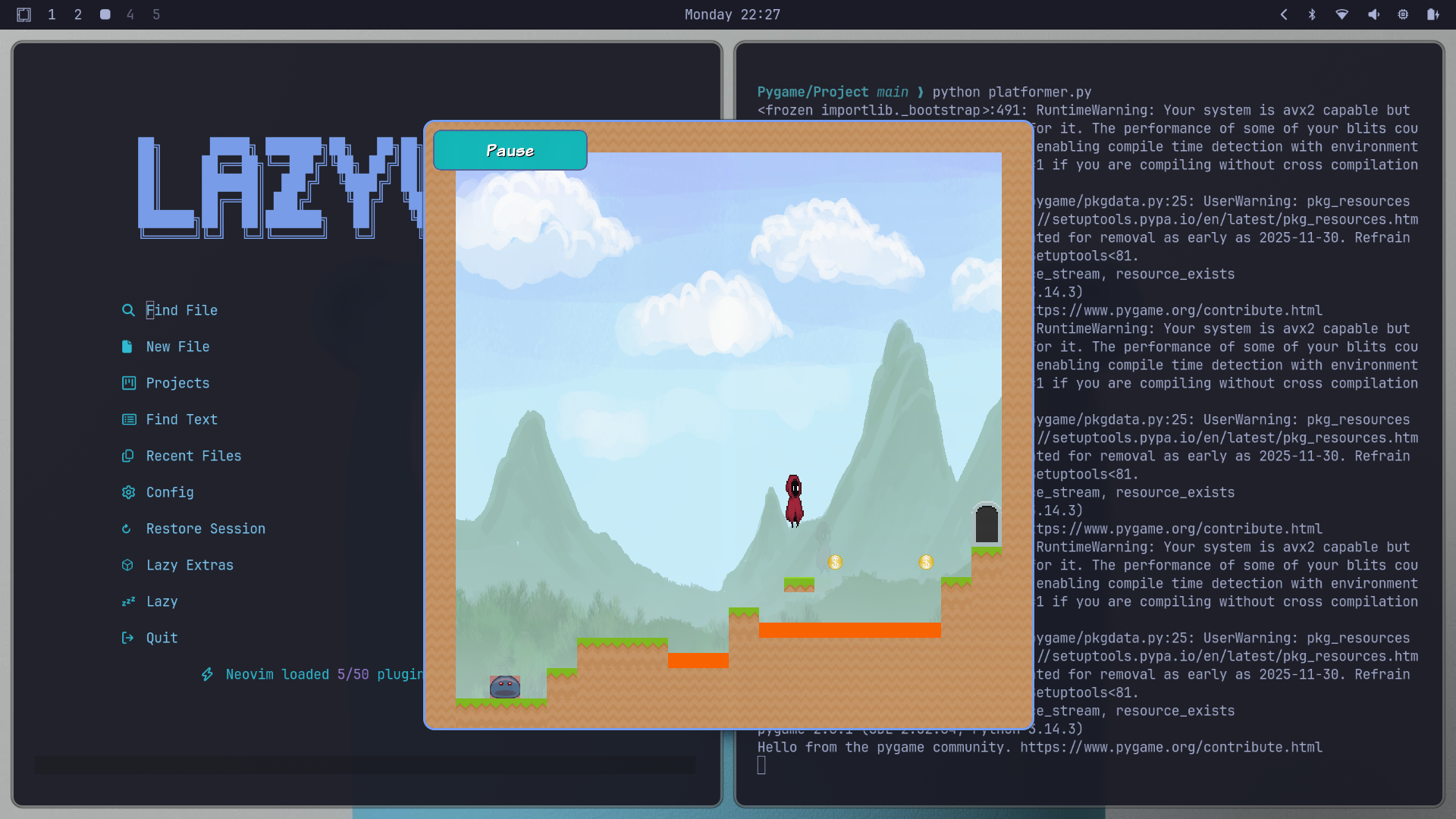
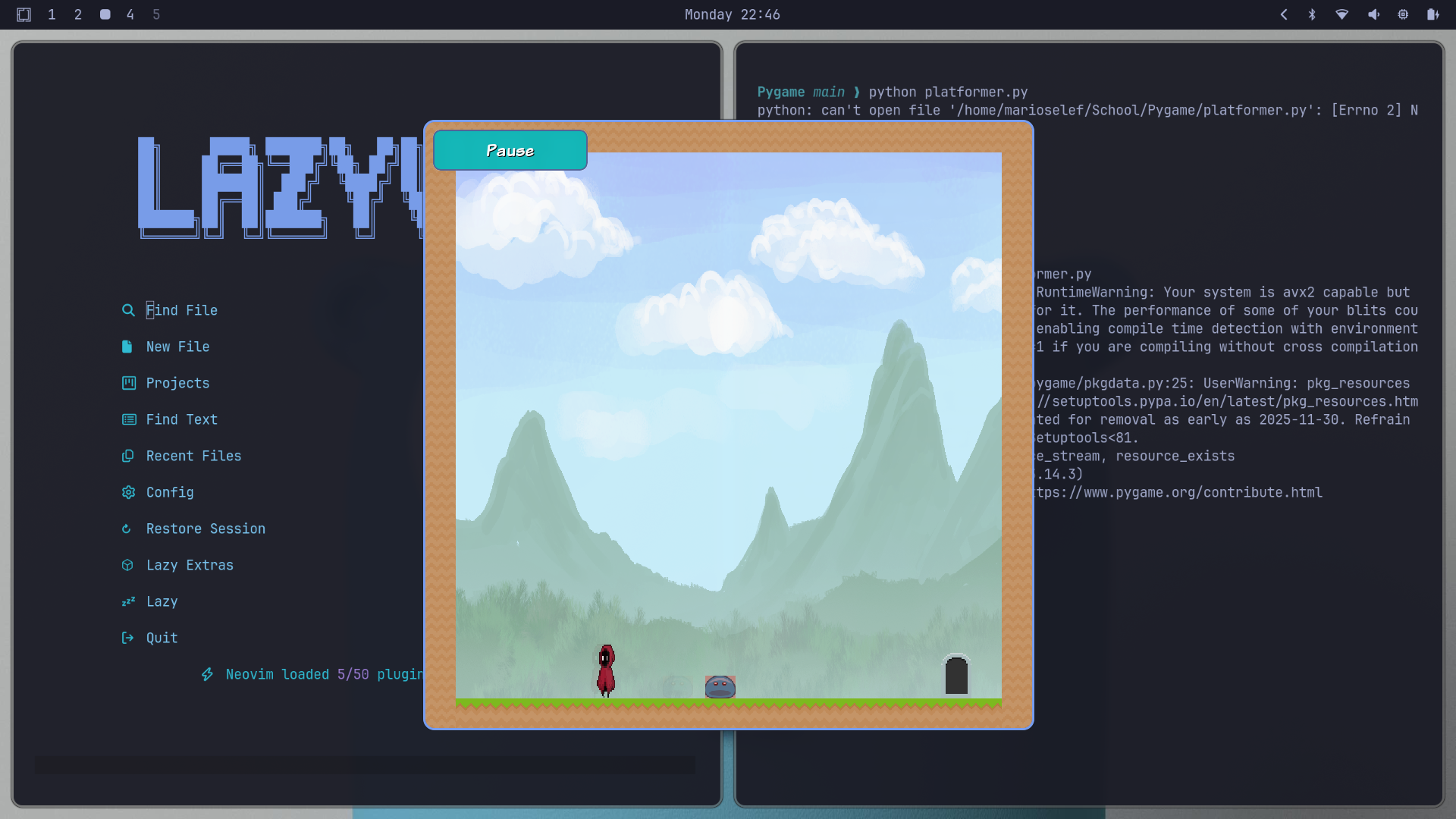
A side-scrolling platformer across five handcrafted levels: run, jump between moving platforms, dodge lava, collect coins and reach the exit door, while enemies patrol until they notice the player, then give chase. Every level was made in the game's own level editor.
What I built
- Physics from scratch. Gravity, jumping and collision are worked out every frame at 60 frames a second, checking the two axes separately so the player never snags on a corner.
- Enemies that react. Two kinds of enemy measure their distance to the player every frame. The green blob notices at 150 pixels and chases fast; the red chaser notices from 200 pixels but chases slower, persistent rather than overwhelming.
- Moving platforms. Platforms that slide sideways or rise and fall, carrying the player along as they move.
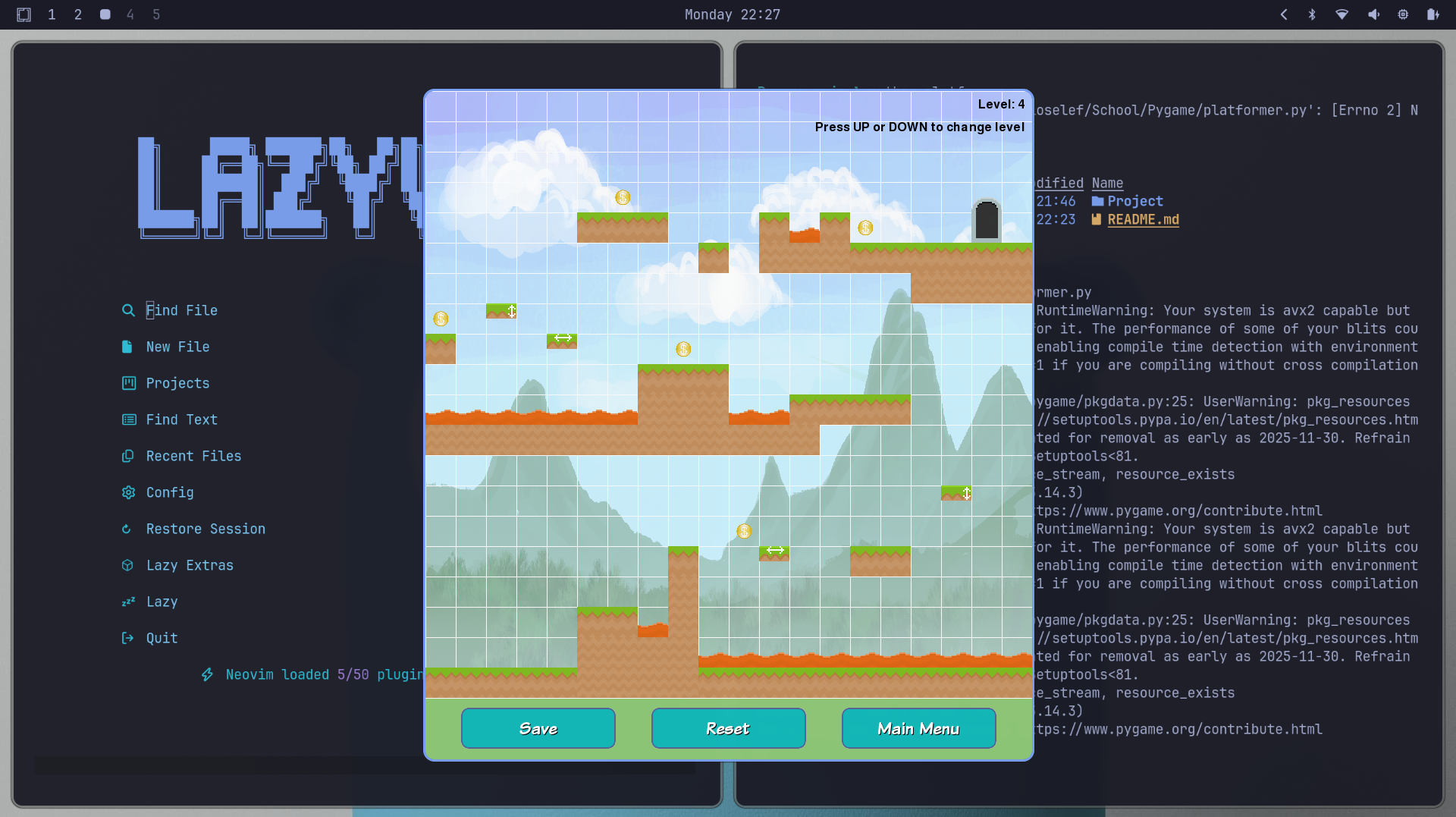
- A level editor. Click through the tiles of a 20 by 20 grid and save the level to disk; the game loads the levels in order.
- Everything a game needs. A main menu, pause, game over and victory screens, music and sound effects.
How an enemy decides
distance_to_player = math.sqrt((self.rect.centerx - player.rect.centerx)**2 +
                              (self.rect.centery - player.rect.centery)**2)

if distance_to_player < self.chase_distance and game_over == 0:
    if player.rect.centerx < self.rect.centerx:
        dx = -self.chase_speed
        self.move_direction = -1
    elif player.rect.centerx > self.rect.centerx:
        dx = self.chase_speed
        self.move_direction = 1
else:
    dx = self.move_direction * self.patrol_speed
    self.move_counter += self.patrol_speed
    if abs(self.move_counter) > self.patrol_distance:
        self.move_direction *= -1
        self.move_counter = 0
Questions about the design
Why work out the physics by hand?
Pygame draws the screen and plays sound, but leaves movement to the game. Writing gravity, jumping and collision directly keeps every rule visible and easy to tune: a jump starts at 15 pixels a frame upward, and gravity takes one away each frame.
Why measure distance in a circle?
The straight-line distance, rather than only the horizontal gap, lets an enemy notice the player above or below it too, the way something actually looking would.
How are levels stored?
Each level is a 20 by 20 grid of numbers, one per tile, saved with Python's pickle. The editor writes it; the game reads it and places a tile, an enemy, a platform or a coin for each number.